
“We Can Do This” – David’s Story of Resilience, Community, and Disaster Recovery
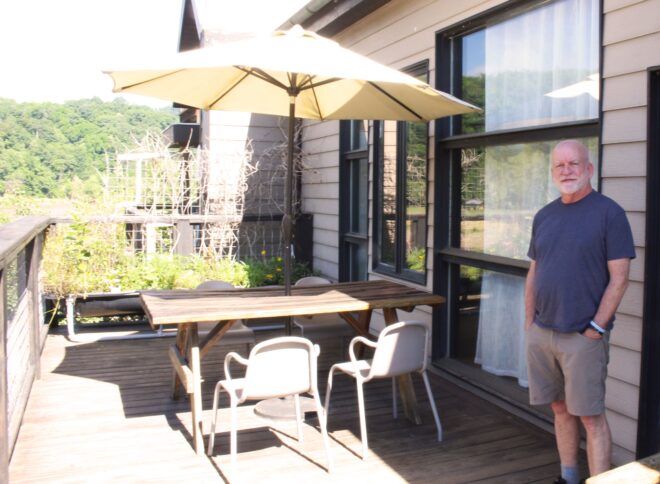
David first discovered Marshall when taking his aging mother on excursions throughout Western North Carolina sixteen years ago. One visit to the town tucked along the French Broad River was all it took.
“The town is kind of magical,” said David. “It’s hard to describe, but it has the same effect on everybody who visits pretty much.”
He stumbled across a “For Sale” sign on Main Street on that first visit. The former auto dealership turned artist studio/home seemed like the perfect place to retire later, and that’s just what he ended up doing.
David and his former partner slowly made repairs and renovations to the home, adding their own touches to what was already a unique space. The town grew alongside David’s life there. He became active in the community, made close friends, and found a sense of belonging. When Hurricane Helene hit, it was that sense of community that kept David going.
The devastation was overwhelming but help from local advocates and Pisgah Legal Services enabled him to appeal a denial from FEMA and eventually receive the maximum amount in home repair. That victory made a substantial psychological difference to David, leaving him feeling like “we can do this” as he worked to rebuild and start again alongside the rest of the town. Marshall was not just a place to live – it was a home worth fighting for, and recovery felt more in reach.
Picking Up the Pieces
The town rallied after the storm. Entire houses floated down Main Street, and windows were blown out by the force of raging waters. David and others who helped clean up in the days after waded knee-deep through mud to remove 12 dump truck loads of ruined belongings from his home. He documented every item lost in a spreadsheet. Like so many, the loss impacted David not just financially but emotionally – seeing so many belongings and memories destroyed.
With large, gallery-style rooms and no furnishings on the lower level to indicate it was living space, FEMA initially denied the claim, classifying it as a business rather than David’s primary residence. Despite the emotional toll, David did what he could and started pulling money from his retirement savings to begin repairs.
“We couldn’t not fix it,” said David. “Not just from a financial standpoint but because the spirit in Marshall is so high. There’s so much positivity and so much community help. Of course I had to come back. We all sort of supported each other.”
Turning the Corner with Legal Help
At community meetings, David met an advocate from Madison Alliance for Rebuilding Communities (MARC) who helped him start the appeal process and begin collecting documentation to prove it as his primary residence. They referred him to a Pisgah Legal Services Disaster Recovery Clinic where he met Attorney Max Gibbons and things started to change.
- Watch a video about David and Pisgah Legal’s work to assist him and others in WNC who are still recovering from Hurricane Helene.
Max spent over two hours with David, helping him rewrite and strengthen his appeal. Together, they created a compelling 76-page affidavit, complete with 15 exhibits, including spreadsheets, mail, and affidavits from friends attesting to his full-time residence.
“It was really impressive,” David said. “Max and I were both proud of it.”
With some final touches from volunteers at Harvard Law School, David was approved for the maximum FEMA amount for home repairs of $42,500 shortly after submitting his appeal, and with additional recovery aid, the total came to around $50,000. The win gave David a sense of hope.
“It felt like we were turning the corner,” said David.
Don’t Give Up – Help is Out There
David’s advice to others going through recovery after disaster: Don’t give up.
“Continue to look for resources,” said David. “Pisgah Legal Services knows what is possible. … I always had the impression that anything that could possibly be done for me on my behalf, by Pisgah Legal and other people that helped, would be done. Take full advantage and say, ‘What else can we do? What can I do next?’”
David said he never felt like he got special treatment – just that he got lucky in getting connected to the right people at the right time. That sense of community and the people in it are something he does not take for granted after this experience. Following the storm, community members came together to support each other in any way that they could, whether it was staffing first-aid tents or cleaning and painting. David said that by everybody pitching in, it made the burden much easier to bear.
“I learned things about personal resilience and what’s important,” said David. “It’s not stuff. It’s people. It’s relationships. It’s community. I was always engaged in the community, but this was so much more – so much different.”
The magic of Marshall is still alive for David. He hopes to one day transform part of the downstairs space into artist studios for others displaced by the storm. The road ahead will not be easy, but with a deeper understanding of what community really means – and with the support of organizations like Pisgah Legal – we can do this.